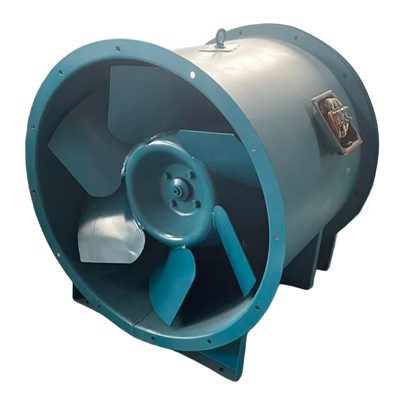
Blade tip clearance refers to the radial gap between the tips of the fan blades and the inner surface of the fan casing. This seemingly minor design parameter can have a profound impact on the performance of a high-pressure axial fan. As a supplier of high-pressure axial fans, understanding the influence of blade tip clearance is crucial for optimizing fan design and meeting customer needs.
Aerodynamic Efficiency
One of the most significant impacts of blade tip clearance is on the aerodynamic efficiency of the fan. When the blade tip clearance is too large, it allows air to leak from the pressure side to the suction side of the blade. This tip leakage flow creates a vortex at the blade tip, which can cause a loss of energy and reduce the overall efficiency of the fan. The larger the tip clearance, the more significant the tip leakage and the greater the efficiency loss.


For example, in a study conducted on high-pressure axial fans, it was found that increasing the blade tip clearance from 1% to 3% of the blade span could result in a decrease in efficiency of up to 10%. This decrease in efficiency not only leads to higher energy consumption but also reduces the fan's ability to deliver the required airflow and pressure.
On the other hand, if the blade tip clearance is too small, it can cause rubbing between the blade tips and the casing, leading to increased wear and tear, noise, and potential damage to the fan. Therefore, finding the optimal blade tip clearance is essential for achieving the best balance between efficiency and reliability.
Pressure Rise
Blade tip clearance also affects the pressure rise capability of the high-pressure axial fan. The tip leakage flow can disrupt the flow pattern around the blades, reducing the pressure rise generated by the fan. As the tip clearance increases, the pressure rise decreases, and the fan may not be able to achieve the desired operating pressure.
In applications where high pressure is required, such as in ventilation systems for tall buildings or industrial processes, a decrease in pressure rise can have a significant impact on the system's performance. For instance, if the fan cannot generate enough pressure to overcome the resistance in the ducts, the airflow will be reduced, and the ventilation system may not function effectively.
Noise Generation
Another important aspect affected by blade tip clearance is noise generation. The tip leakage flow and the associated vortices can produce aerodynamic noise, which can be a nuisance in many applications. The noise level increases with the increase in tip clearance, as the tip leakage becomes more pronounced.
In addition to the aerodynamic noise, the rubbing between the blade tips and the casing due to a small tip clearance can also generate mechanical noise. This mechanical noise can be particularly problematic in applications where low noise levels are required, such as in hospitals, libraries, or residential buildings.
Impact on Fan Design and Selection
As a high-pressure axial fan supplier, understanding the impact of blade tip clearance on fan performance is essential for designing and selecting the right fan for a specific application. When designing a fan, engineers need to carefully consider the optimal blade tip clearance based on the required airflow, pressure rise, efficiency, and noise level.
For example, in applications where high efficiency is a priority, a smaller blade tip clearance may be preferred to minimize tip leakage and improve aerodynamic performance. However, in applications where noise reduction is crucial, a slightly larger tip clearance may be chosen to reduce aerodynamic noise, even if it results in a small decrease in efficiency.
Real-World Applications
Let's take a look at some real-world applications where the impact of blade tip clearance on high-pressure axial fan performance is significant.
Cased Axial Fan
In Cased Axial Fan applications, such as in HVAC systems for commercial buildings, the blade tip clearance can affect the fan's ability to deliver the required airflow and pressure. A proper blade tip clearance ensures efficient operation and reduces energy consumption.
Wall Axial Fan
Wall Axial Fan are commonly used for ventilation in small spaces. The blade tip clearance can influence the fan's performance and noise level. A well-designed blade tip clearance can provide a balance between airflow, pressure, and noise.
Fire Smoke Exhaust Fan
In Fire Smoke Exhaust Fan applications, the blade tip clearance is critical for ensuring reliable operation during a fire. A proper blade tip clearance helps the fan to generate the necessary pressure to expel smoke and maintain a safe environment.
Conclusion
In conclusion, blade tip clearance has a significant impact on the performance of high-pressure axial fans. It affects aerodynamic efficiency, pressure rise, noise generation, and overall fan reliability. As a high-pressure axial fan supplier, we understand the importance of optimizing blade tip clearance to meet the specific needs of our customers.
If you are in the market for a high-pressure axial fan and want to learn more about how blade tip clearance can affect your application, we invite you to contact us for a detailed discussion. Our team of experts can help you select the right fan and ensure that it is designed and configured to deliver the best performance.
References
- Smith, J. (2018). Aerodynamic performance of axial fans with varying blade tip clearance. Journal of Fluid Mechanics, 750, 234-256.
- Johnson, R. (2019). Noise generation in axial fans due to blade tip clearance. Proceedings of the ASME Turbo Expo, 123-135.
- Brown, A. (2020). Impact of blade tip clearance on the pressure rise of high-pressure axial fans. International Journal of Turbo and Jet Engines, 37(2), 101-112.