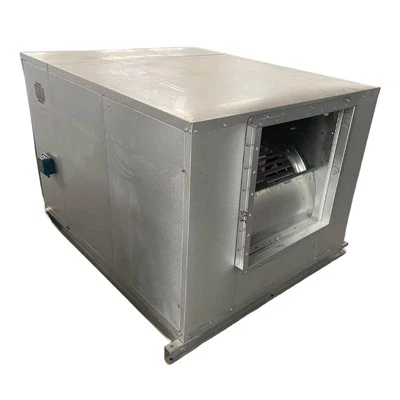
As a supplier of duct axial fans, understanding how to measure the efficiency of these fans is crucial. Not only does it help us provide high - quality products to our customers, but it also allows us to optimize our manufacturing processes. In this blog, we will explore the various methods to measure the efficiency of a duct axial fan.
Understanding the Basics of Duct Axial Fans
Duct axial fans are designed to move air along the axis of the fan. They are commonly used in ventilation systems, where they are responsible for drawing in fresh air and expelling stale air. The efficiency of a duct axial fan is a measure of how effectively it can convert electrical energy into mechanical energy to move air.

Key Parameters for Measuring Efficiency
Airflow Rate
The airflow rate, usually measured in cubic feet per minute (CFM) or cubic meters per hour (m³/h), is a fundamental parameter. It represents the volume of air that the fan can move in a given time. A higher airflow rate generally indicates a more efficient fan, but it is not the only factor to consider. To measure the airflow rate, we can use an anemometer. Place the anemometer at the outlet of the duct axial fan and take multiple readings at different points across the outlet. Then, calculate the average airflow rate.
Static Pressure
Static pressure is the resistance that the fan has to overcome to move air through the duct system. It is measured in inches of water column (in. WC) or pascals (Pa). A fan with a higher static pressure can push air through a more restrictive duct system. To measure static pressure, we can use a manometer. Connect the manometer to the duct at a point near the fan inlet and outlet. The difference in pressure between the inlet and outlet gives the static pressure of the fan.
Power Consumption
Power consumption is the amount of electrical energy the fan uses. It is measured in watts (W). A more efficient fan will consume less power while achieving the same airflow rate and static pressure. To measure power consumption, we can use a power meter. Connect the power meter to the fan's electrical supply and record the power consumption during operation.
Calculating Fan Efficiency
The efficiency of a duct axial fan can be calculated using the following formula:
Efficiency (%) = (Airpower / Input Power) × 100
Airpower is the power required to move the air and is calculated as:
Airpower (W) = (Airflow Rate × Static Pressure) / 6356 (when airflow is in CFM and static pressure is in in. WC)
Input Power is the electrical power consumed by the fan, measured in watts.
For example, if a fan has an airflow rate of 2000 CFM, a static pressure of 1 in. WC, and an input power of 200 W, the airpower is calculated as:
Airpower = (2000 × 1) / 6356 ≈ 0.3146 hp. Converting hp to watts (1 hp = 746 W), airpower ≈ 0.3146 × 746 ≈ 234.7 W
Efficiency = (234.7 / 200) × 100 = 117.35% (Note: In real - world scenarios, efficiency values above 100% are due to measurement errors or approximations)
Factors Affecting Fan Efficiency
Blade Design
The shape and angle of the fan blades have a significant impact on efficiency. Well - designed blades can generate more airflow with less power consumption. For example, backward - curved blades are generally more efficient than forward - curved blades because they produce less turbulence.
Motor Efficiency
The motor that drives the fan also affects its overall efficiency. High - efficiency motors convert electrical energy into mechanical energy more effectively, reducing power consumption.
Duct System Design
The design of the duct system, including its length, diameter, and number of bends, can impact the fan's efficiency. A well - designed duct system with smooth transitions and minimal bends will reduce the static pressure that the fan has to overcome, improving efficiency.
Importance of Measuring Fan Efficiency
Energy Savings
By accurately measuring the efficiency of duct axial fans, we can identify inefficient fans and replace them with more energy - efficient models. This can lead to significant energy savings for our customers, especially in large - scale ventilation systems.
System Performance
Efficient fans ensure that the ventilation system operates at its optimal level. They can provide better air quality by effectively moving air in and out of the space, reducing the risk of mold growth and improving the comfort of the occupants.
Our Product Range
We offer a variety of duct axial fans, including Kitchen Axial Fan, Square Axial Fan, and Cased Axial Fan. Each of these fans is designed to meet different ventilation needs and is manufactured with high - quality materials to ensure maximum efficiency.
Contact Us for Procurement
If you are interested in purchasing our duct axial fans or have any questions about measuring fan efficiency, please feel free to contact us. We are committed to providing you with the best products and services to meet your ventilation requirements.
References
- ASHRAE Handbook - HVAC Systems and Equipment. American Society of Heating, Refrigerating and Air - Conditioning Engineers.
- Fan Engineering, 8th Edition. Buffalo Forge Company.
- Air Movement and Control Association (AMCA) Standards.